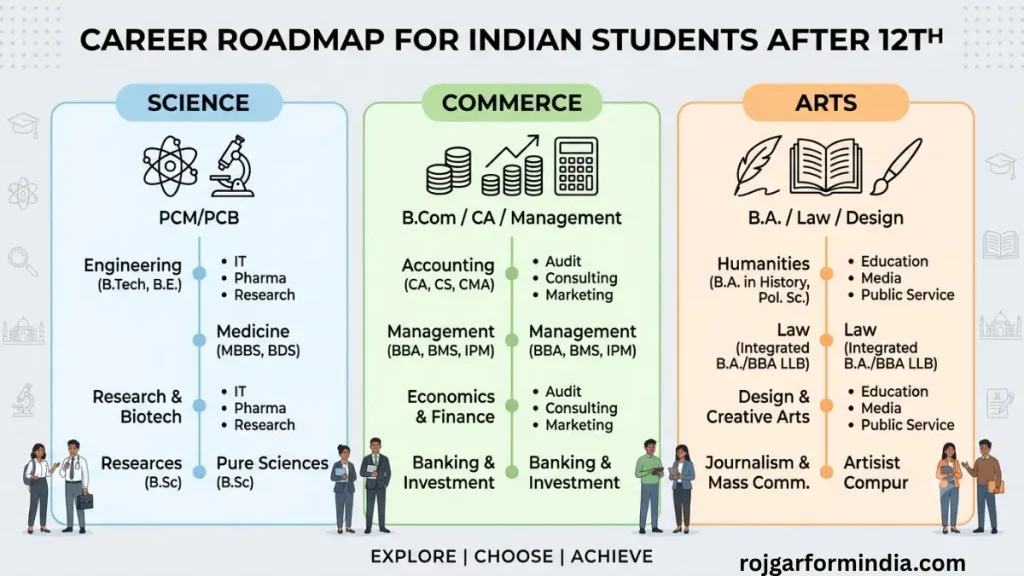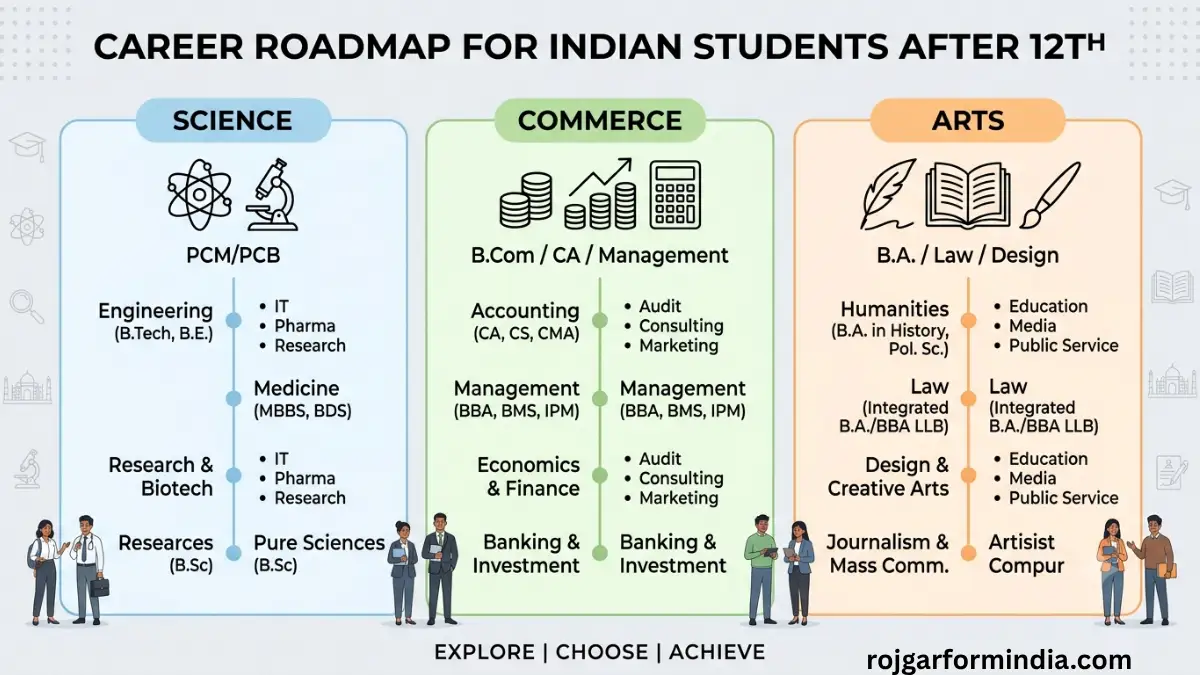
Choosing what to do after Class 12 can be confusing. Some students want a government job, some plan to attend college, and others want to learn a practical skill and start earning. The right decision depends on your subjects, interests, budget, eligibility and long-term plans.
This After 12th Career Roadmap explains the main options available to Indian students, how they differ, where to check official information and how to make a realistic plan instead of choosing a course just because others are doing it.
1. Career Options After 12th at a Glance
Students do not have to follow the same route after Class 12. Compare the main pathways before deciding where to spend your time and money.
| Career Path | Suitable For | What Comes Next? |
|---|---|---|
| Graduation | Students planning a degree and further study | BA, B.Com, B.Sc. and other eligible degree programmes |
| Professional Courses | Students interested in a specific profession | Law, healthcare, management and other regulated fields |
| Government Jobs | Students interested in public-sector employment | Eligible recruitment exams and selection processes |
| ITI Courses | Students who prefer practical or technical training | Trade training, apprenticeships and relevant jobs |
| Diploma Courses | Students interested in technical or vocational education | Further study, technical roles or eligible recruitment |
| Skill-Based Learning | Students wanting to develop practical abilities | Portfolio building, internships and entry-level opportunities |
| Entrepreneurship | Students interested in running a small business | Business planning, customer research and practical experience |
Remember: A course does not guarantee a job. Check its recognition, total fees, eligibility, placement information and actual career opportunities before enrolling.
2. Best Courses After 12th by Stream
Your Class 12 stream can help narrow down your choices, but the admission rules of the particular course will decide whether you qualify.
Career Options After 12th Science
| Course or Route | Who Should Explore It? | What to Check |
|---|---|---|
| B.Sc. Programmes | Students interested in science subjects | Required subjects, marks and college eligibility |
| Engineering | Students interested in technology and engineering | Mathematics requirements, entrance exams and admission rules |
| Medical and Allied Health Courses | Students interested in healthcare | Required subjects, entrance tests and applicable professional rules |
| Computer and IT Courses | Students interested in computing | Mathematics requirements, course syllabus and practical training |
| Diploma or Technical Training | Students who prefer hands-on learning | Recognition, admission eligibility and training facilities |
Career Options After 12th Commerce
| Course or Route | Main Area | Possible Next Step |
|---|---|---|
| B.Com. | Accounting, commerce and business | Accounts, finance-related study or further qualifications |
| BBA | Management and business | Entry-level business roles or postgraduate study |
| Economics | Economic analysis and research | Further study and eligible analytical roles |
| Professional Finance Courses | Accounting, taxation or finance | Check the relevant professional body’s entry rules |
| Banking Exam Preparation | Banking and financial services | Apply when an official recruitment notification matches your qualification |
Career Options After 12th Arts or Humanities
| Course or Route | Main Area | Possible Next Step |
|---|---|---|
| BA | Humanities and social sciences | Further study, competitive exams or relevant entry-level work |
| Law | Legal education | Apply through the admission route accepted by the institution |
| Journalism and Media | Writing, reporting and communication | Practical projects, internships and media roles |
| Social Work | Community and social development | Further study and relevant sector opportunities |
| Design and Creative Courses | Visual communication and creative work | Build a portfolio and check course-specific entry requirements |
Students from any stream should check individual admission notices. A course that accepts one stream may require specific subjects, entrance scores or additional qualifications.
3. Government Jobs After 12th
Government recruitment is one possible route after Class 12, but every post has its own age limit, educational requirements, physical standards where applicable and selection process.
| Recruitment Area | Examples to Research | Important Check |
|---|---|---|
| SSC Recruitment | CHSL and other eligible examinations | Current notification, age limit and examination rules |
| Railway Recruitment | Posts for which Class 12 is an accepted qualification | Exact post requirements and the applicable RRB notification |
| Defence Services | Eligible entry schemes and recruitment categories | Age, education, medical and physical standards |
| Police Recruitment | State police posts accepting the qualification | State rules, physical tests and additional conditions |
| State Government Jobs | Clerical and other eligible posts | State-specific notification and language requirements |
| Apprenticeships | Training opportunities in eligible organisations | Trade, qualification, stipend and training conditions |
How to Find Suitable Government Jobs
- Check your age and educational qualification against the official notification.
- Read the syllabus and selection stages before starting preparation.
- Keep your Class 10 and Class 12 certificates, photo ID and other required documents ready.
- Apply only through the official recruitment portal mentioned in the notification.
- Save the application confirmation and keep checking official updates.
Do not assume that every Class 12 pass student can apply for every recruitment. Some posts require particular subjects, technical qualifications, physical fitness or other conditions.
Students can also explore related recruitment updates on Rojgar Form India. Before applying, always verify vacancies, dates and eligibility from the recruiting authority.
4. Diploma, ITI and Skill-Based Training
A traditional degree is not the only option. Students who prefer practical learning can compare diploma programmes, ITI trades, apprenticeships and skill courses.
| Option | Main Benefit | Before Joining |
|---|---|---|
| ITI | Trade-focused practical training | Check trade recognition, duration and admission rules |
| Polytechnic Diploma | Technical education in selected fields | Confirm entry eligibility, fees and institution recognition |
| Apprenticeship | Structured workplace training | Read the training terms, stipend and completion conditions |
| Digital Skills | Practical computer and online-work abilities | Check course quality and practise through projects |
| Communication Skills | Helps with interviews and workplace interaction | Practise speaking, writing and professional communication |
Students interested in digital work can start with basic computer skills, spreadsheets, writing, design tools or introductory programming, depending on their interests.
Free or affordable learning resources may be available, but course access, certificates and fees can differ. Read the details on the provider’s official website.
5. How to Choose the Right Career After 12th
Before paying admission fees or beginning exam preparation, answer these questions honestly.
| Question | Why It Matters |
|---|---|
| Which subjects do I enjoy? | Interest can help you stay motivated during study. |
| What is my available budget? | Tuition, travel, accommodation and exam fees can add up. |
| Do I want further study or an earlier job? | Different routes require different time commitments. |
| What are my strengths? | Technical, analytical, creative and communication skills suit different pathways. |
| What are the actual eligibility rules? | Your preferred course or job may require particular subjects or qualifications. |
| What is the backup plan? | Another suitable option can help if admission or recruitment does not work out. |
A useful approach is to shortlist three options: your first choice, a realistic alternative and a backup. Compare them using the same criteria instead of making a decision based only on salary claims or social media advice.
6. A Practical 90-Day Career Plan
Use this simple plan to turn a general idea into a set of achievable tasks.
| Period | What to Do |
|---|---|
| Days 1–15 | List your interests, subjects, marks, budget and preferred work location. |
| Days 16–30 | Research three suitable courses or recruitment routes using official websites. |
| Days 31–45 | Compare eligibility, fees, duration, entrance requirements and career pathways. |
| Days 46–60 | Begin preparation for the selected route and improve one relevant skill. |
| Days 61–75 | Check application dates, admission notices, documents and deadlines. |
| Days 76–90 | Review your progress, complete pending applications and adjust your study plan. |
This is a planning framework, not a promise that admission or employment will happen within 90 days. Some entrance exams, courses and recruitment processes take much longer.
7. Official Websites for Students
Use these resources to explore career options, training and opportunities. Read the relevant terms before registering or paying for any course.
| Resource | What You Can Explore | Official Link |
|---|---|---|
| National Career Service | Career guidance, job searches, career centres and employment services | https://www.ncs.gov.in/ |
| NCERT My Career Advisor | Career exploration and information about different job roles | https://mycareeradvisor.ncert.gov.in/ |
| SWAYAM Plus | Employment-oriented learning and industry-linked courses | https://swayamplus.education.gov.in/ |
| Skill India Digital Hub | Skill-development and training opportunities | https://www.skillindiadigital.gov.in/home |
| National Scholarship Portal | Scholarship information and eligible application services | https://scholarships.gov.in/ |
See More
CG Vyapam FWLN26 Exam Date 2026 – Sample Assistant and Lab Assistant Exam Schedule
KEA Kalyana Karnataka Recruitment 2026: Before You Apply, Know These Important Details
IBPS RRB 15th Recruitment 2026 – Apply Online for Office Assistant and Officer Posts
How to Apply for a Government Job Online: Complete Step-by-Step Guide for Beginners
Odisha Anganwadi Recruitment 2026 – Apply Online for Anganwadi Worker & Helper Posts
The National Career Service provides employment-related services, while NCERT’s My Career Advisor helps students explore career paths. SWAYAM Plus and Skill India Digital Hub can help learners investigate skill-development opportunities.
Safety tip: Do not pay an individual who promises a guaranteed government job. Verify recruitment notices, application fees and course recognition through the appropriate official authority.
8. Common Mistakes to Avoid
- Choosing a course only because friends or relatives recommend it.
- Paying large fees before checking recognition and the complete course cost.
- Assuming a government job is guaranteed after passing an examination.
- Ignoring age limits, required subjects or other eligibility conditions.
- Collecting certificates without practising the skills relevant to your goal.
- Depending on unofficial social media posts for application dates.
- Preparing for several unrelated exams without a clear timetable.
A little research before enrolment can save both time and money. Keep a record of official links, application dates, documents and the next action required for each option.
9. Frequently Asked Questions
| No. | Question | Answer |
|---|---|---|
| Q1 | What is the best career option after 12th in India? | There is no single best option for everyone. Compare your interests, eligibility, budget and long-term plans before choosing. |
| Q2 | Can I prepare for government jobs after Class 12? | Yes, you can explore recruitments that accept Class 12 qualifications. Check the official notification for each post. |
| Q3 | Can I learn a skill while studying for graduation? | Yes. Choose a manageable course that supports your interests and leaves enough time for your main studies. |
| Q4 | Is ITI better than graduation? | They serve different purposes. Compare the trade or degree, training quality, costs and career requirements before deciding. |
| Q5 | Where can I find genuine career guidance? | You can explore the National Career Service and NCERT My Career Advisor websites listed above. |
| Q6 | Are online skill courses always free? | No. Some are free, while others charge for learning, assessment or certificates. Check the official course details. |
| Q7 | Should I take admission before checking the course recognition? | No. Confirm recognition, eligibility, total fees and the institution’s official details first. |
| Q8 | How can I keep track of government job opportunities? | Follow the official recruitment websites and verify each notification before applying. You can also use Rojgar Form India to discover relevant updates. |
Note
Har student ka career path alag hota hai, isliye kisi doosre ko dekhkar wahi course choose na karein. Pehle information check karein, phir apni situation ke hisaab se decision lein. Fees jama karne ya form submit karne se pehle official details dobara dekhna na bhoolein. Rojgar Form India par milne wali job updates ko bhi final application se pehle official notification se verify karein.